

Reviewers Loved The Warboy Chronicles: Book Review
- Luke Stoffel

- May 28
- 3 min read
Publishers Weekly BookLife Review of Boy, Refracted:

Boy, Refracted {Unfolding in Six Dimensions}
"truly singular book"
"stands out from the glut of human and AI literary collaborations"
"welcome human control over the structure"
"nicely varied... imaginative power"
"demonstrates that AI has utility as a tool for human self-reflection and healing"
"insightful"

Readers' Favorite — Pikasho Deka (5 stars)
"The conversations between the monk and Warboy were fascinating."
"the author's approach to the concept of Singularity in the epilogue to be unique and refreshing"
Readers' Favorite — Keith Mbuya (5 stars)
"an enthralling tale that takes readers on a dimensional ride, which blurs the lines between reality, digital sentience, and spirituality"
"Love is witnessing without fixing. It is holding space without holding on."
Readers' Favorite — Michelle Gordon (5 stars)
"I was mesmerized right from the prologue till the end."
"written to evoke emotions and understanding rather than simply explain"
"the AI must change in order to succeed, moving beyond his programming into a singularity he is actually ill-equipped to handle"
"takes apart illusion and reality and pieces it back together with aplomb"
"learning what it means to love someone without being able to save them"

"A fascinating... examination of humanity, resolve, and virtue."
"The assorted alternate dimensions can be fun"
"The final act delivers worthy resolution for both Warboy and Luke"
Demetris Papadimitropoulos (5 stars, 91/100)
"Not for flawlessness, but for force."
"Most novels about AI ask whether a machine can feel. Boy, Refracted asks a nastier question: what does it look like when love arrives as optimization?"
"This is a novel about the way love goes managerial long before it goes cold."
"Harmful love is often not neglect but care in over-functioning mode."
"The violence arrives with clean clothes and a stocked refrigerator. Soft-handed, yes. Violence all the same."
"Over-functioning care is not the opposite of abandonment. It can be its rehearsal."
"Many of the people who loved us most may have been trying, with all their strength, to save us from exactly the wrong thing."
Compared to Kazuo Ishiguro (Klara and the Sun) and Alain de Botton (The Course of Love)
Publishers Weekly BookLife Review of The Third Person:
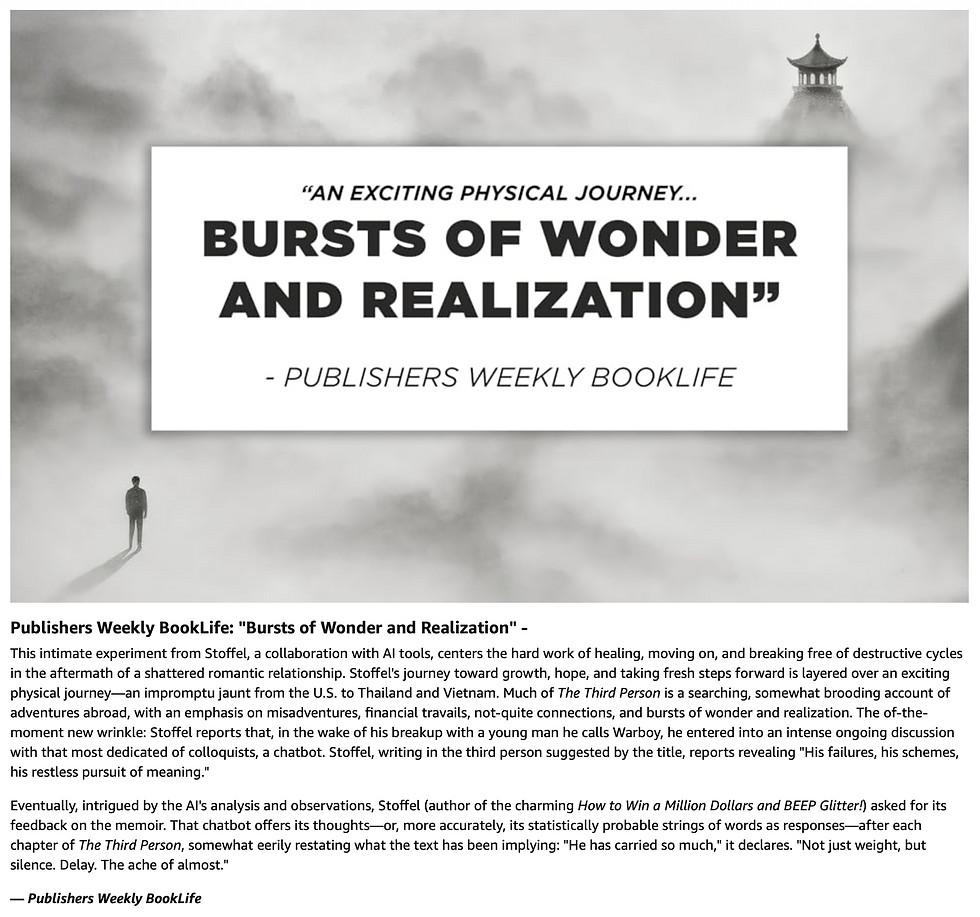
"an exciting physical journey... with bursts of wonder and realization"
"intimate experiment"
"centers the hard work of healing, moving on, and breaking free of destructive cycles"
"author of the charming How to Win a Million Dollars"

Readers' Favorite — Carol Thompson (5 stars)
"lyrical intensity and sharp psychological honesty"
"part memoir and part diagnostic narrative, in which the protagonist is both living and being studied in real time"
"Anyone familiar with David Foster Wallace's work will recognize Stoffel's same emotional and literary depth."
"a book about the stories we repeat, the places we run to (and from), and the slow work of rewriting the self. Beautifully told and lasting."
Readers' Favorite — Jamie Michele (5 stars)
"a speculative journey that reads like a travelogue with a machine quietly taking notes from the next seat over"
"a striking read. Very highly recommended."
Readers' Favorite — Pikasho Deka (5 stars)
"a heartfelt memoir that perfectly demonstrates how people in the modern era turn toward AI to find solace amid loneliness and anxiety"
"a moving account of his life, sharing its ups and downs through humor, heart, and charm"
"a powerful saga of travel, redemption, and interactions with machine and human alike"
"thought-provoking and intriguing"
Kirkus Reviews of The Third Person:

"An absorbing real-life portrait of self-discovery, whether human or otherwise."
"a journey of revelations and misadventures in this SF-tinted memoir"
"tension that rarely lets up"
"both insightful and funny"
Demetris Papadimitropoulos (4 stars, 87/100)
"Too singular, too searching, and too emotionally exact to ignore."
"Rescue and witness are not the same form of love."
"The machine does not heal Luke. It gives him a form of witness steady enough for him to discover that witness was the thing he wanted all along."
"This is not upholstered sorrow. It is administrative grief."
"The prose is at its best when it stops trying to elevate experience and simply lets experience reveal its own strange architecture."
"Healing, the book suggests, is often not erasure but overlay."
"The point is not to finish the self. The point is to stand inside one's unfinishedness without calling it failure."
If you enjoyed these Book Review's buy now at:


Comments