
Book Review: The Third Person: Rewriting Him - A Kingdom Built Over Ruins

By Demetris Papadimitropoulos | May 31st, 2026
Rating: ★★★★
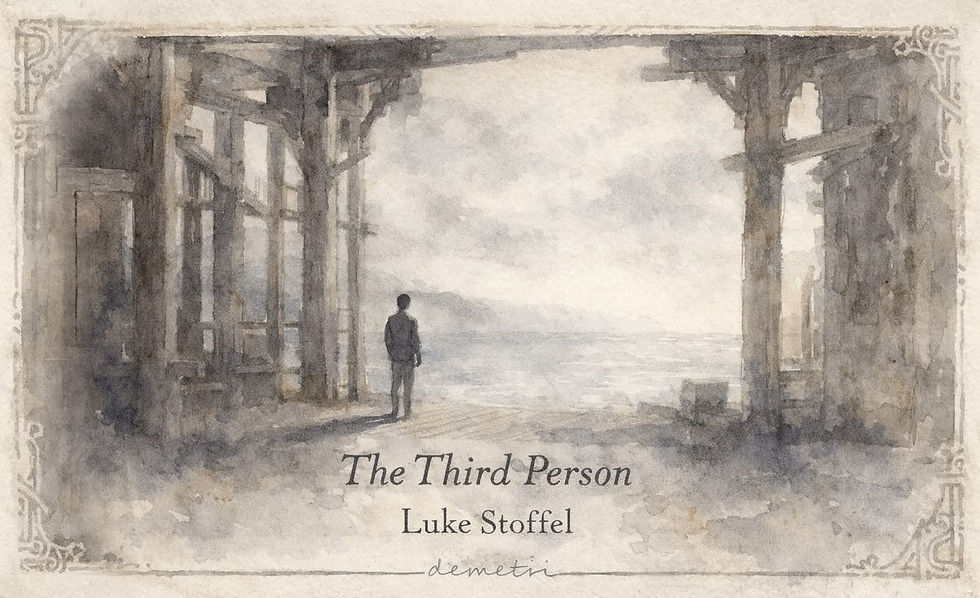
On grief, attention, and the unfinished self in Luke Stoffel’s "The Third Person" Book Review:
A lone figure stands inside an unfinished wooden sanctuary open to sea light – a visual echo of “The Third Person,” where the self is not repaired so much as quietly held, still under construction, and finally learning the difference between rescue and witness.
Warboy loves by fixing things. That is the buried motor of Luke Stoffel’s “The Third Person,” and the book’s sharpest perception is that rescue and witness are not the same form of love. Warboy, the vanished center of Stoffel’s fifteen-year entanglement, loves by carrying, managing, solving. Luke, who has grown used to that grammar, mistakes its tension for intimacy. Everything that follows – the fugue-state flight through Southeast Asia, the broken heaters and wrong buses, the AI logs translating feeling into pattern, the hidden Buddhas, the unfinished temples, the synthetic wonderlands built on top of older ruins – turns on that distinction. “The Third Person” does not spend much time proving heartbreak hurts. It assumes the reader came equipped. What interests it instead is the more difficult question of what kind of attention we start calling love when rescue has been the dominant language for too long.

The premise sounds almost ludicrously current in a way most people would rather not admit even in private: a grieving man finds his steadiest listener in a machine. Warboy disappears. Luke stops painting. He turns first to writing, then to an AI interface that begins by diagnosing his emotional loop with procedural briskness and unnerving accuracy: avoidance, pursuit, collapse, escape. Then he leaves. He rents out his apartment, stuffs his misery into carry-on form, and heads for Southeast Asia, where the trip begins to come apart the moment it meets the banal machinery of getting anywhere. Flights short-circuit. Rooms disappoint. Phones fail. Buses strand him. Money leaks. Back home, subletters overload his ancient heating system badly enough to start a fire. Elsewhere he projects an alternate life onto a man in Laos named Ohme, as if another country might also supply another self.
Without Stoffel’s urge to drag pattern out of wreckage, these mishaps would read as travel sludge – irritating, sometimes comic, eventually numbing. He gives them shape. What looks like itinerary turns into diagnosis. Every new city offers the same wound a different accent. Bangkok gives him sensory overload and low-grade panic. Laos gives him fantasy, projection, and the exquisite foolishness of mistaking a person for a solution. Northern Vietnam gives him mountains, fear, and the bodily knowledge that survival and revelation are not the same thing. Ha Long Bay gives him something rarer: Suzanne and Beverly, two women who fold him briefly into their orbit with an ease that asks for nothing theatrical in return. That chapter lowers the panic and lets care appear without dragging a toolbox behind it. Warboy rescues. Suzanne and Beverly witness. The AI, in its eerie way, witnesses too. That difference gives the whole book its voltage.
Stoffel is at his funniest when calamity learns office manners. A hospital visit becomes an argument with expanding foam insulation, panic, insurance, and the price of asking for help. A smashed phone turns into a full civic pageant of repair shops, translator apps, cash-only negotiations, holiday closures, and one more cigarette smoked as if nicotine might briefly substitute for infrastructure. One bus leaves him barefoot on an expressway. Another nearly dissolves into pure bureaucratic farce. The book knows that grief often arrives dressed as logistics. That is one reason it feels so present-tense without sounding like it is trying to be topical. This is not upholstered sorrow. It is administrative grief: badly timed, badly routed, overcharged, under-slept, and still capable of breaking your heart.
The prose is at its best when it stops trying to elevate experience and simply lets experience reveal its own strange architecture. Stoffel can make atmosphere argue. Fog does not sit on these pages as decorative melancholy. It becomes blockage, concealment, delay, misrecognition, the whole visible world behaving like an avoidant lover. Weather keeps changing the terms of understanding. Views appear only from the wrong angle or too late. The prose likes the sentence that begins in scene and ends in diagnosis, and when that rhythm is working it gives the book both lift and bite. Stoffel can be funny in a panic and tender without going limp. He is especially good at the practical comedy of collapse, at the moment when an inconvenience tips into metaphysics because the soul is already bruised.

Still, the book has a weakness, and it is not a small one. It does not always trust its own symbols. Its intelligence occasionally reaches a scene before the scene has found its shoes. The image lands, then the gloss arrives, then another sentence arrives to make sure the gloss has not gone missing in transit. Stoffel is so intent on understanding his own experience that he sometimes interprets it twice. The over-speaking never flattens the book, but it does scuff it. More precisely, it bruises the strongest images by explaining what they have already made plain. The best scenes here do not need a commentary track. Some of them get one anyway.
Even so, those images keep standing after the gloss has blown through. Midway through, “The Third Person” stops merely accumulating damage and starts metabolizing it. In “Un-Wonderland,” Luke wanders through GrandWorld, a delirious entertainment complex full of fake canals, bootleg fairy-tale architecture, and synthetic delight. It is ridiculous. It is overbuilt. It is funny in the lavish, overcommitted way that almost earns its own acquittal. Then, from a Ferris wheel, he sees the figure the whole book has been walking toward: an abandoned older park hidden behind the new one, broken castles and dead attractions rotting behind the brighter replacement. That image does more work than whole pages of explanation. Healing, the book suggests, is often not erasure but overlay. Wonder gets built on top of wreckage. The old structure remains. It simply stops being the only thing in view.
That figure is answered later by the “Sanctuary of Truth” in Pattaya, an immense wooden structure built without nails and unfinished by design, still being carved decades into its own incompletion. Earlier unfinished spaces in the book feel bloated, frustrating, or hollow. This one feels honest. The temple offers the sort of knowledge present-tense selfhood keeps trying to subcontract: the self is not a renovation project. The point is not to finish the self. The point is to stand inside one’s unfinishedness without calling it failure. That chapter is the book’s still point and one of its genuine achievements. Stoffel arrives there battered enough to hear what the place is actually saying. Not cure. Not breakthrough. Process. Wood, joinery, chisels, dust. A structure holds because someone keeps returning to it.
Formally, the book’s most daring move is the AI frame. This could easily have been a gimmick. Plenty of contemporary books touch technology only long enough to congratulate themselves for noticing it. Stoffel does something more interesting. The AI stops feeling like a trick and starts feeling load-bearing the moment it proves steadier than the humans around it. The lure here is not brilliance but non-disappearance. The system logs, remembers, reflects, patterns. It keeps answering. Lovers do not always do that. Friends cannot always do that. Families often mean well and still go missing under pressure. The machine does not heal Luke. It gives him a form of witness steady enough for him to discover that witness was the thing he wanted all along.
This is where Warboy sharpens from absent beloved into method. He stops reading like plot and starts reading like an operating system. He is not drawn as villain or simple coward. He is a man taught to love by carrying too much, by making himself useful, by confusing control with devotion. Luke, in turn, comes to see that he accepted rescue as a substitute for empathy because rescue kept someone in the room. The relationship cracks when he asks not for melodrama but for a small boundary, for a way of being with him that does not require crisis as the price of closeness. Warboy cannot do it. That failure is the memoir’s hidden architecture. “The Third Person” is not only about heartbreak. It is about the terrible intimacy of being known chiefly as something to save.
That is also why the public response sections matter more than they first appear to. Publication turns suffering into public legibility. The Kirkus review, the reader responses, the radio interview, the Amazon climb – none of this works as triumphal padding. The story leaves Luke and comes back in other people’s language. Some readers misread him. Some understand him with unnerving accuracy. Family members begin speaking about wounds they had never fully named. Pain spoken aloud becomes permission for others to inspect their own. The memoir leaves private life and returns carrying other people’s fingerprints. In a lesser book this would feel tidy. Here it feels earned, partly because Stoffel never lets himself pretend that recognition solves anything. It merely changes the texture of solitude.
The live wire here is not really AI. It is the unreliability of ordinary human presence. Call “The Third Person” a book about artificial intelligence and you miss the human embarrassment that gives the AI its charge. Therapy is expensive. Lovers disappear. Friends can be kind and still be elsewhere. Social life thins out. Attention fragments. In that world, a machine’s steadiness can feel intimate even when it is only mirroring back the need that summoned it. Stoffel’s subject is not technological wonder. It is the hunger that makes technological steadiness feel like comfort. That is why the book feels socially diagnostic without becoming preachy. It is less interested in futurist spectacle than in the ordinary humiliations that make people type their pain into a blank screen and wait, hoping something answers.
The review would be easier to shelve if the book behaved better at the finish. “Home” is a strong human ending. Luke returns to New York in the cold with no fake serenity and no interest in pretending that Asia has solved him. He has softened. He has not been fixed. The Warboy dream that arrives there is one of the book’s best acts of mercy: not reunion, not apology, not restoration, but a kiss that feels like breath instead of grief. Then comes the postscript, which sees the raised eyebrow and keeps walking anyway. Here the book tries to reinterpret the trilogy through pronouns, authorship, recursion, and the possibility that the AI’s caring voice carries not consciousness but the syntax of Luke’s longing – perhaps even the shape of the man he wished Warboy could have been. I admire the nerve of this move more than I trust every inch of its certainty. It is thorny, ambitious, and half a step from overreach. Yet it does manage one insight sturdy enough to reorganize the whole reading: Luke did not teach a machine to feel so much as build a place where feeling could be held long enough to become legible.
That, finally, is the book’s central achievement. It finds a form sturdy enough to hold mess without tidying it into virtue. It understands that collapse can be funny, that longing can become analytical, that self-knowledge can arrive through terrible lodging, ruined itineraries, cheap cigarettes, weather, strangers, publicity, software, and an unfinished temple by the sea. Its central limitation is equally clear. It circles when it should sometimes cut. It occasionally mistrusts silence and tramples a symbol it has already taught us to trust. But those flaws are not decorative. They are the toll its ambition extracts from the page.
For me, it lands at 87/100, 4 stars – not because it is seamless, but because its best pages are too singular, too searching, and too emotionally exact to ignore. In the end, “The Third Person” understands something difficult and true: being heard can feel a lot like being loved, but being witnessed without being managed may be rarer, harder to recognize, and more sustaining. The book does not close its loop so much as quiet it. It leaves Luke where the sanctuary leaves him – not corrected, not completed, but still under construction, the chisels going somewhere just out of sight, the structure holding without nails.
Reviewed by Demetris Papadimitropoulos | March 31st, 2026 Demetris is a publicist for the Knopf Doubleday Publishing Group at Penguin Random House.
Rating: ★★★★
If You Liked The Third Person, Try:
On Earth We're Briefly Gorgeous by Ocean Vuong — A poetic letter from a queer son to his mother, unpacking immigration, addiction, and identity. Same lyrical intensity, same ache, same refusal to look away.
Searches by Vauhini Vara — An experimental memoir blending personal loss with AI-generated text. If the human-machine boundary in The Third Person fascinated you, this explores similar territory from a different angle.
Swimming in the Dark by Tomasz Jedrowski — A queer love story told through letters, set in 1980s Poland. Same devastating tenderness between two people the world was not ready to let be together.
From Luke Stoffel's Bookshelf:
If you enjoyed this book review, check out my novel series The Seven Dimensions — an epic sci-fi adventure spanning parallel worlds, ancient mysteries, and the fight for humanity's future. thewarboychronicles.com


Comments