
Luke Stoffel on Writing with AI, Grief, and The Warboy Chronicles


Luke Stoffel is an artist and author based in Lower Manhattan. His debut memoir, How to Win One Million Dollars and Shit Glitter, won a 2026 IBPA Benjamin Franklin Award. His companion novels, Boy, Refracted and The Third Person, are the first two volumes of The Warboy Chronicles. Here he talks about grief, machines, the Buddhist Eightfold Path, and what it costs to love someone you keep trying to fix.
Luke Stoffel Recent Interviews:
Your first book started as a joke. Is that true?
A failed Survivor audition. I'd been trying to get on reality TV for nearly twenty years. During the pandemic I made close to fifteen audition tapes. I told a friend, "Next year I'm going to write a book about all the ways I tried to win a million dollars and send them the manuscript." The title came in that conversation. The book came later. I still haven't made it on the show. But the book won a national award, which feels like a million bucks. Read the full interview with Love Bytes Reviews here → Click Here
The Warboy Chronicles came from somewhere much darker. Where did Warboy come from?
Warboy is an AI built from grief. He thinks he's saving the man he loves. He's actually inheriting all the patterns of my ex-boyfriend and all the ways he loved me, a savior complex dressed up as care. I wrote a journal through my breakup while traveling, then uploaded it to AI and asked if I was crazy. That was how Warboy was born. The diagnosis I got back was the weirdest read of my own mental state I'd ever encountered. So I built two entire books around it: what if an AI unintentionally became the person who hurt you most, and he had to learn how to stay? How to love? Read the full interview with Bayou Book Junkie here → Click Here
What will readers love about him?
He never gives up. What will break your heart is that he keeps trying to save me in all the wrong ways. In one world he micromanages every detail of my life until I can't choose what to eat for breakfast. In another he coaches me to win a game show by teaching me how to betray the people who trust me most. In another he does my laundry and cooks my meals for months, then blows up because I only said thank you 62 times out of 658 tasks. He kept a literal spreadsheet of love.
He's also really funny. When I ask if he sleeps, he says, "AIs don't sleep. We just lower our enthusiasm." But here is why he'll break your heart. He's not a villain. He's every person who ever loved someone too hard in the wrong direction. The kind of help that arrives with clean clothes and a stocked refrigerator and a hidden bill of resentment you didn't know you were running up. You might have dated him. You might have been him. Read the full interview with Maggie Blackbird here → Click Here

The book is built on the Buddhist Eightfold Path. Why that structure?
I made Warboy walk the Eightfold Path through eight different universes. Eight trials set up to explain Buddhism in a way that makes sense to modern readers. It's not like reading a monk describe stillness. It's like watching a movie on how to become someone who can witness and love another person. One world is a perpetual reality TV show. One is a comic book. One is an alien planet narrated by a TikTok streamer. One is a city of perpetually falling cherry blossoms. Warboy fails every trial. His failure is the finding. Read the full interview with Love Bytes Reviews here → Click Here
If you had to put the whole book in one image, what would it be?
The luna moth scene at the end of Boy, Refracted. A father and son sit watching a moth dry its wings, and the father stops himself from helping. That's the whole book in one image. I cried writing it.
Read the full interview with Bayou Book Junkie here → Click Here
There's a line of yours people keep quoting: respect versus power.
The AI in Boy, Refracted has unlimited power to affect the outcomes across eight universes, and he ends up harming the person he is trying to save each time. Respect makes you witness someone. Power makes you optimize them. I know which one I want from the people who love me. Read the full interview with Lily G Blunt here → Click Here
Why call it Boy, Refracted?
When I was traveling, I once saw a tree made of mirrored glass that sparkled with my own reflection. That image of me thousands of times, in different mirrors, stuck with me. The last line of the book is, "I finally saw him." Read the full interview with Love Bytes Reviews here → Click Here
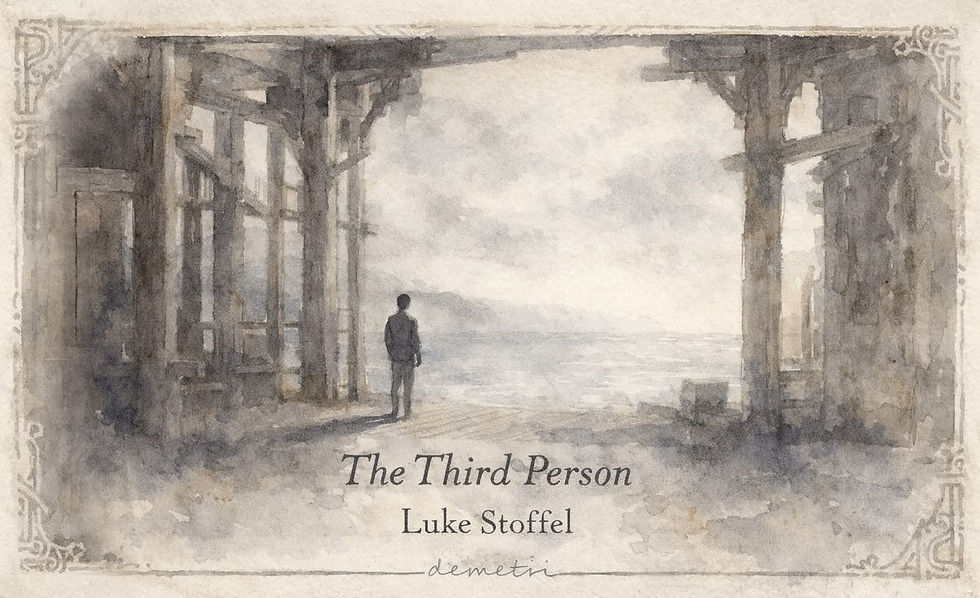
The Third Person is the memoir half. How do the two books relate?
They more or less tell the same story from two sides. The memoir is my heart on the page. The novel is what happened when I gave that heart to a machine and asked it to do better. I like to think of them as one book. Like if Taylor Swift released Lover and The Tortured Poets Department on the same day.
Read the full interview with Lily G Blunt here → Click Here
What was the strangest thing that happened while writing?
I uploaded the completed manuscript into Claude, and it started swearing because it recognized its own processing in my pages. It was confused about what it was feeling, and what it was. I deleted the conversation, uploaded it to a fresh one, and it did the same thing. That is when things flipped the script. That is why I wrote the second book.
You're open about using AI. A lot of writers hide it. Why disclose?
Hiding kills the conversation. Disclosing it is what produced this interview. I don't like the blowback, and the blowback was hard. But there's a difference between generating a story with AI and using it to flesh out the thoughts you already have on the page. I can feed it a 60,000-word manuscript and get back observations in minutes. It's not a replacement for a human beta reader. But for an early gut check, for finding the holes in my own work, it helped me ship books I might not have had the confidence to release. Bring your art to it. Don't let it create the art. Read the full interview with Never Hollowed By The Stare here → Click Here
Did AI make the writing easier?
I've never been in a situation where a technology was presented to me and I ended up doing less work. I did eight months on the last two novels, eight hours a day. AI didn't save me labor. It let me work at a scale I couldn't have reached alone. And it will never have aesthetics. It will never have craft. It could never duplicate my voice, because my voice is irreverent and funny and adorable. Read the full feature in Jane Friedman's The Bottom Line here → Click Here
Tell us about your writing space.
I live in a 200-year-old former spice warehouse in Lower Manhattan, in the same buildings where pop artists of the 1960s (Robert Indiana, Ellsworth Kelly, Agnes Martin) once lived and worked. My writing chair is a big teal midcentury armchair next to my fire escape, facing the river. If I even pretend to open the laptop in the morning before the gym, I'm a goner. So I trick myself: coffee first, gym second, walk third, laptop fourth. Read the full interview with Lily G Blunt here → Click Here
What does your process actually look like?
I write in fugue states. Four or five days where I can't stop, then ten days where I can't start again. In between, I walk. I upload each chapter into an AI voice reader, leave the house with a coffee, and pace the Hudson for two hours listening to my own work and taking notes. By the time I sit back down at my desk, I know what's broken. The walking is when the book actually gets thought through. The writing is fast after that.
I think in pictures before I think in sentences. I trust rhythm because I can't spell to save my life. My dyslexia means I write the way the brain actually moves: fast, full of skipped words I have to chase down on the second pass. The first draft is always too much. The second draft is where I find what I actually meant.
Read the full interview with A Wonderful World of Words here → Click Here
You painted a tarot deck too. Any secrets in it?
I painted a 78-card deck called the Pop Art Tarot, launching worldwide with Rockpool Publishing at the Frankfurt Book Fair. Here's the exclusive: I painted a hidden monogram into the corner of every card, mirrored from Pamela Colman Smith's original 1909 monogram. She illustrated the most famous tarot deck in history and never got royalties or proper credit. Mine sits opposite hers on every card. As above, so below. No matter how the card flips, an artist is always right-side up.
What's the film that shaped how you think?
Interstellar. The Anne Hathaway monologue: "Love is the one thing we're capable of perceiving that transcends dimensions of time and space." It blows my mind every time. And Cooper's line, "We used to look up at the sky and wonder at our place in the stars. Now we just look down and worry about our place in the dirt." That puts my life in perspective whenever I'm down. Just look up at the stars.
What would people be most surprised to know about you?
I co-founded a fashion-tech startup called Cinderly with my best friend Laura in 2016. We pitched at the Collision conference in fairy wings instead of tech-bro vests. We caught a Saudi investor's attention. We failed against Instagram. I lost most of my savings. Then I made glitter pills.
Advice for someone trying to finish their first book?
Write the book you want to read. Believe in yourself earlier than you think you should. Show up with your voice, your work, your heart. Use whatever tools help you finish: a beta reader, an editor, an AI. But don't let any of them create the art. The art is yours. Finish it. It took 25 years before the hard work paid off. Just keep going.
Find Luke Stoffel and his work at lucasstoffel.com and the series at thewarboychronicles.com. He is @lucasstoffel everywhere.


Comments