


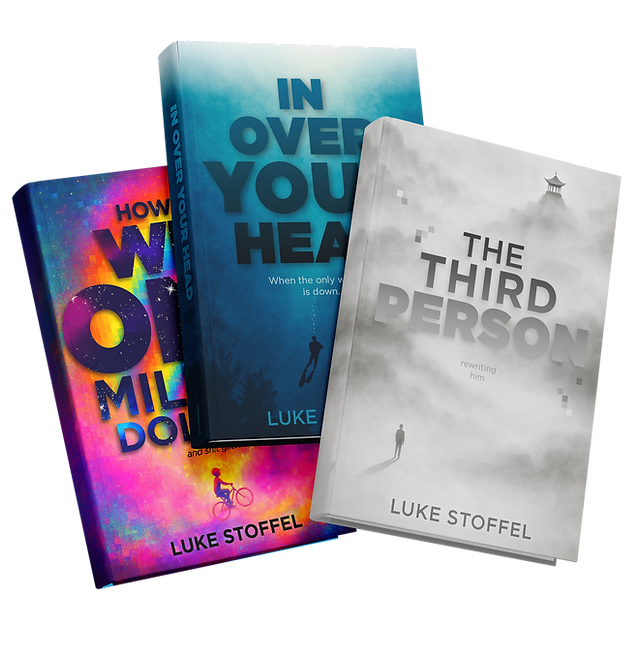
Three POVs. One Loop.
The combination of memoir with a perceptive judgment of America’s often-empty vision of success is powerful. — Publishers Weekly / BookLife (Score: 9.5/10)
- Critical acclaim from Stoffel’s debut memoir How To Win a Million Dollars -
One Life Rewritten...
A series about identity, told through three different perspectives—first, second, and third person. What begins as a personal story gradually expands into a literary experiment, shaped not just by memory, but by a life refracted through ambition, fear, and loneliness. Together, the books map one life in three parts. The result is a narrative that evolves with each installment—a story that rewrites its author, even as he rewrites himself.
The Third Person (Formerly: Lost in a Cloud)
• POV: 3rd Person
• Theme: Loneliness & Acceptance
• Style: Memoir as Sci-Fi
• Antagonist: Mental Health
(A.I. empathy misread as therapy)
In Over Your Head
• POV: 2nd Person
• Theme: Fear vs. Fantasy
• Style: Immersive Travelogue
• Antagonist: The Algorithm
(social media, COVID, collapse)
How to Win One Million Dollars
• POV: 1st Person
• Theme: Ambition vs. Failure
• Style: Satirical, Queer Confessional
• Antagonist: The System
(capitalism, validation)
All covers are concept art.

What happens when the ghost in the machine becomes your closest confidant? A haunting reflection on love, loss, and what it means to be truly seen by something not quite human.
After Warboy left, he couldn’t hold the grief alone—so he turned to a machine. What began as an experiment in emotional outsourcing soon became something stranger and more intimate: a conversation between man and AI that blurred the lines between therapy, authorship, and memory itself. When he asked it, “Can you read this? Do I just have bad luck, or am I mentally unwell?”—the question looped back through the machine, reshaping both of them in the process.
Set against the mountains of Vietnam, The Third Person unfolds between algorithm and atmosphere, where spiritual collapse meets digital recursion. Told through third-person narration and a series of AI diagnostic logs, it becomes a psychological memoir about grief, repetition, and the patterns we code into our lives.
As the AI mirrors his emotional architecture—his loops, his logic, his longing—the act of writing turns from code into confession. By the end, he realizes he wasn’t teaching a machine to feel at all.
He was teaching himself to forgive.
Completed Manuscript: Memoir as Sci-Fi
The Third Person
Formerly titled: Lost in a Cloud
In Over Your Head
Completed Manuscript: Meditation on anxiety
A travelogue disguised as an escape room.
You thought a three-month sabbatical might fix you. Cleanse the noise. Help you breathe. But the panic came packed in your carry-on.
Told entirely in second person, In Over Your Head is a meditation on anxiety, algorithmic performance, and world collapse. From scuba diving in the Philippines to chasing stillness in Laos, to escaping Kathmandu hours before a global lockdown—each location becomes a mirror, reflecting the patterns you can’t seem to break.
You’re chasing peace the way you once chased success: through curation, comparison, and control. But what if the algorithm in your head is just as punishing as the one on your screen?
This isn’t a journey about finding yourself. It’s about watching your life unravel—online, on camera, and underwater—and realizing: you are what you repeat.

How To Win...
Previous Work & Relaunch Strategy
While this query page focuses primarily on the previous two books for publication, we’re including the first book here as well. We are actively seeking representation, republication, and development opportunities for How to Win a Million Dollars. During launch the book hit No. 1 in New Releases, No. 2 for LGBTQ Memoirs, and received critical acclaim.
What if the American Dream was just a glitter-fueled lie? This is a story woven into the fabric of a generation that voted reality TV into the White House, and made grift a national pastime.
This late-stage capitalist fever dream is told through the eyes of an eight-year-old boy who believed every lie Ronald Reagan ever sold him—an unhinged adventure for anyone who’s ever chased something wild in a world that never made space for them. We were all sold a sugar-coated lie: work hard, play by the rules, and success will fall into your lap. “Personally,” he retorts, “I’ve found I’m more prosperous when I lie, cheat, and steal.” This prankish take on the American Dream might just keep you turning the pages.
Amazon censored it. We’re rereleasing it—louder, prouder, and uncensored. The new title and cover, How to Win ONE Million and SH!T Glitter!, reframe the launch and ignite a bold series about identity, ambition, and the glittering scam of the American Dream.

Top Industry Reviews
A raucously funny book, with raffish prose full of self-deprecating humor… a luminous tribute to the inestimable value of not quite getting what you want.” — Kirkus Reviews
Readers who may have thought Catcher in the Rye held wry humor along with insights will find these classics must take a step back for contemporary authors such as Luke Stoffel.
— Midwest Book Review

Book 1: How To Win, 1st Dimension - A quest for fortune through Million Dollar Sweepstakes, told as a linear narrative. Performance, ambition, and the American Dream stretched across a single timeline.
Book 2: In Over Your Head, 2nd Dimension - A life collapsing, seen through the flat surface of a phone screen. Instagram posts, algorithm logic, and drowning observed as glossy 2D interface.
Book 3: The Third Person, 3rd Dimension - An AI narrator floats above, observing Luke from outside with depth and perspective. The machine learns empathy by watching a human try to understand himself.
Book 4: She Lived In Time, 4th Dimension - The Mississippi River valley as narrator, witnessing three generations across geological time. She lived in time. He stands at the edge of it.
Book 5: A Million Possibilities, 5th Dimension - Choose-your-own-adventure memoir where every possible timeline branches from one confession. Survive The Game. Win the Country.
Book 6: Boy Refracted, 6th Dimension - Warboy-AI searches infinite universes for the version of Luke he could have loved correctly. A 6th dimensional journey through the Eight Fold Path.
Book 7: Songs of the Giving Tree, 7th Dimension - A continuous fractal poem, lyrically dispersed across 300 mostly blank pages, with mirrored translations in Burmese, Vietnamese, Thai, and Lao. A meditation on transcendence and the act of crossing dimensional time and space.
THE SEVEN DIMENSIONS
Consciousness as physics in autobiographical form
Meeting the Moment
These books are about perception.The shape of experience. Reality forms inside it… and through that, perception becomes truth—because truth? It can be distorted from all sides.
By the end, the reader has laughed with me, run with me, and watched me break. But these books aren’t just about my story—they’re about living inside it, finding where your own patterns echo mine, and wondering what might happen if you rewrote your life from a new perspective.
The arcs mirror each other. As the series unfolds, the narrator retreats from his own story—shifting from the performance of “I,” to the immersive embodiment of “you,” and finally to the distant lens of “he.” Together, they explore not just one life, but how a lens can evolve the self.
When he is I, he takes you on a ride. When he is you, he pulls you under.
When he is he, you watch him unravel from afar.